
A few years ago, when people talked about AI and digital marketing, it often sounded like something that was still far away.
Today, that is no longer the case.
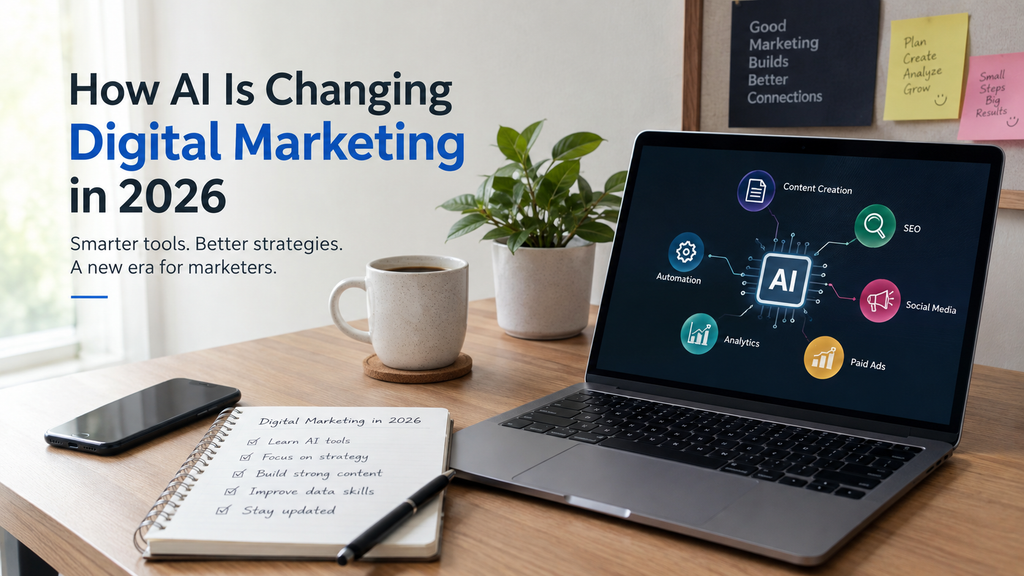
AI is already sitting inside many of the tools digital marketers use every day. From creating content and researching keywords to analyzing campaigns and generating ad ideas, AI has become a regular part of the marketing workflow.
And honestly, I don’t think the biggest change is that AI can now do things faster.
The bigger change is that the role of a digital marketer is changing.
Tasks that used to take hours can sometimes be completed in minutes. Search is becoming more conversational. Advertising platforms are becoming more automated. Content production has become much faster.
But at the same time, there is a new problem.
When everyone has access to AI, simply knowing how to use ChatGPT or another AI tool is no longer enough.
The real skill is knowing what to ask, what to create, what to change, and what not to trust.
So, let’s look at what AI is actually changing in digital marketing in 2026.
AI Is Changing the Way Digital Marketers Work
One of the biggest advantages of AI is simple: it saves time.
Think about the number of small tasks a digital marketer handles every day.
Researching ideas.
Writing drafts.
Creating captions.
Analyzing data.
Preparing reports.
Brainstorming advertisements.
Finding content gaps.
Creating variations of headlines.
AI can help with many of these things.
But I don’t see AI as a replacement for the marketer.
I see it more as a productivity partner.
Instead of spending two hours doing something manually, a marketer can use AI to get a first draft or initial analysis and then spend more time improving it.
That difference may seem small, but over a month, it can save a huge amount of time.
What Is Happening to SEO Because of AI?
SEO is probably one of the areas where the impact of AI is easiest to notice.
For years, SEO was heavily focused on keywords, rankings, backlinks, technical SEO and search engine algorithms.
These things still matter.
But search behavior is changing.
People aren’t always typing a short keyword into Google anymore. They are asking longer, more natural questions and expecting direct answers.
Someone might not search only for:
“digital marketing course”
They might ask:
“Is digital marketing a good career for someone starting in 2026?”
Or:
“Which digital marketing skills should a beginner learn first?”
That changes the way we need to think about content.
It’s no longer enough to write an article simply because a keyword has search volume.
You need to understand what the person is actually trying to find out.
That’s where search intent becomes extremely important.
Content Is Easier to Create. Good Content Is Not.
This is probably one of the most interesting things happening right now.
AI has made content creation incredibly easy.
You can get blog ideas, social media captions, video scripts, email drafts and content outlines almost instantly.
Sounds great, right?
It is.
But there is a downside.
Because creating content is easier, there is now a lot more content being produced.
And unfortunately, a lot of it sounds exactly the same.
You read one article, then another, and then another—and after a while, everything starts sounding like the same article with different words.
This is where I think human input becomes even more important.
Your own experience.
Your opinions.
Your examples.
Your mistakes.
Your way of explaining something.
Those are the things AI doesn’t automatically have.
So, instead of using AI to write everything for you, I think the better approach is to use AI to help you write better.
Let AI help with the first draft.
Then bring your own experience into it.
That’s where the real value comes from.
Social Media Marketing Is Getting Faster
Social media marketers have another interesting relationship with AI.
There is always a need for new content.
New posts.
New reels.
New hooks.
New captions.
New ideas.
And trying to come up with something fresh every single day can get exhausting.
AI can make this process much easier.
You can take one idea and turn it into multiple pieces of content.
For example, one blog post could become:
- an Instagram carousel
- a LinkedIn post
- a short video script
- a Reel idea
- an email
- several social media posts
That saves a lot of time.
But there’s something I think marketers should be careful about.
Don’t let AI remove your personality.
People follow people because they feel some kind of connection with them.
If every post sounds perfectly polished, perfectly structured and completely generic, people eventually stop noticing it.
AI can help you create content.
But your personality is what makes people remember it.
AI Is Changing Paid Advertising Too
Paid advertising has also become much more automated.
Platforms are using AI to help with targeting, creative optimization, audience signals and campaign performance.
This means digital marketers don’t necessarily control every single part of a campaign the way they used to.
And I think that’s actually a good thing.
Because it forces marketers to focus on the things that really matter.
What is the offer?
Who is the customer?
What problem are we solving?
What message will make them stop scrolling?
What landing page will convince them to take action?
A marketer who understands these things can get much more value from AI-powered advertising platforms.
Someone who simply knows which buttons to click may struggle.
AI Is Making Personalization More Practical
We’ve been talking about personalized marketing for years.
But AI is making it easier to actually do it.
Instead of sending exactly the same message to everyone, businesses can use customer data and AI to understand different audience groups.
For example, a new visitor might need educational content.
Someone who has already visited the website might need a stronger reason to take action.
An existing customer might need a completely different message.
AI can help marketers identify these differences and automate parts of the communication.
That can make marketing feel more relevant instead of simply sending the same message to everyone.
Data Analysis Is Becoming Easier
Let’s be honest.
Not every digital marketer loves looking at spreadsheets and dashboards.
But data is still one of the most important parts of marketing.
The good news is that AI is making data easier to understand.
Instead of manually going through every number, marketers can use AI-assisted tools to find patterns, summarize performance and highlight areas that need attention.
But there’s one thing I wouldn’t rely on AI for completely.
Judgment.
For example, if website traffic increases by 50%, that sounds great.
But what if conversions went down?
What if the extra traffic wasn’t relevant?
What if the business made less money?
Numbers don’t explain themselves.
A good marketer still needs to understand what the numbers actually mean for the business.
Is AI Going to Replace Digital Marketers?
This is probably the question I hear most when people talk about AI.
And honestly, I don’t think the answer is as simple as yes or no.
I don’t think AI is going to make digital marketers irrelevant.
But I do think it will make some traditional ways of working less valuable.
A marketer who spends hours doing repetitive work that AI can handle may eventually struggle to compete with someone who knows how to automate those tasks.
At the same time, a marketer who understands strategy, customer psychology, creativity, branding and analytics can use AI to become even more effective.
So, for me, the future isn’t:
AI vs Digital Marketers
It’s:
AI + Digital Marketers
The people who learn how to work with AI are likely to have the advantage.
What Skills Should Digital Marketers Learn in 2026?
This is where things get interesting.
With AI handling more repetitive tasks, I think marketers should spend more time developing skills that require actual thinking.
Strategy
Knowing what to do—and why you’re doing it—is becoming more important than simply knowing how to execute a task.
Creativity
AI can give you 100 ideas.
But you still need to know which one is actually worth using.
Analytics
You don’t need to become a data scientist, but you should understand what your marketing numbers are telling you.
Communication
Writing, storytelling, presenting ideas and understanding audiences are still extremely valuable skills.
Customer Psychology
Technology changes quickly.
People don’t.
Understanding what motivates a customer, what stops them from buying and what builds trust will always matter.
AI Skills
You don’t have to become an AI developer.
But you should know how to use AI effectively, write better prompts, evaluate the output and fit AI into your existing marketing workflow.
The Biggest Mistake Marketers Can Make With AI
I think the biggest mistake is trying to automate everything.
Just because AI can do something doesn’t mean it should do it.
For example, you could ask AI to create your entire content strategy.
But if you don’t understand your audience, the strategy may still be weak.
You could ask AI to write ten social media posts.
But if you don’t add your own experience or perspective, they may feel generic.
You could ask AI to analyze your marketing data.
But if you don’t understand your business goals, you may focus on the wrong metrics.
The technology is powerful.
But you still need to know what you’re trying to achieve.
How I Think Digital Marketers Should Use AI in 2026
Personally, I think the best way to use AI is as an assistant—not as the person making every decision.
A simple workflow could look like this:
Research → Strategy → AI Assistance → Human Review → Testing → Analysis → Improvement
AI can help at almost every stage.
But the final decisions should still come from the marketer.
That’s the balance I think is going to matter most.
The Future of Digital Marketing Will Be Human + AI
AI is clearly changing digital marketing.
There is no going back to the way things were.
SEO is changing.
Content creation is changing.
Advertising is changing.
Social media is changing.
Analytics is changing.
Even the way people search for information is changing.
But one thing remains the same.
Marketing is still about people.
You can have the best AI tools in the world, but if you don’t understand your audience, your marketing will still struggle.
You can generate hundreds of pieces of content, but if none of them are useful, you haven’t really solved anything.
You can automate your campaigns, but if your offer is bad, automation won’t save it.
That’s why I don’t think the future belongs to marketers who simply use the most AI tools.
I think it belongs to marketers who know how to combine technology with human thinking.
AI can make us faster.
It can make us more productive.
It can help us analyze more information and experiment with more ideas.
But strategy, creativity, experience and understanding people will still matter.
And that’s probably the most important lesson for digital marketers in 2026:
Don’t compete with AI. Learn how to work with it.
Hi, this is a comment.
To get started with moderating, editing, and deleting comments, please visit the Comments screen in the dashboard.
Commenter avatars come from Gravatar.